Bondo Original Filler — Professional Auto Body Repair
Our Original Filler is the two-part polyester resin system trusted by body shops and DIY enthusiasts for over six decades. It cures hard in 15 minutes, sands smooth without pin-holing, and bonds permanently to bare metal, fiberglass, and galvanized steel.
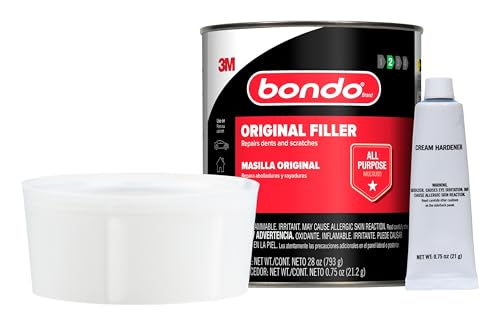


Our Original Filler uses a catalyzed polyester resin that cross-links chemically when you knead the red hardener cream into the tan base. Unlike air-dry fillers that remain soft beneath the surface, this system forms molecular bonds that lock the repair into place.
Mixing ratio and working time
We designed the hardener tube to dispense the correct catalyst volume when you squeeze a ribbon across the filler mound. For a golf-ball-size portion, knead a 1-inch bead of red cream into the tan base until the color turns uniform pink with no streaks.
Too little hardener extends working time but leaves the filler tacky; too much shortens your window and can cause micro-cracking as the exotherm spikes. The sweet spot gives you three to five minutes to spread the filler before it firms up enough to resist the spreader. We recommend mixing only what you can apply in one pass — catalyzed filler can’t be re-thinned or saved.
Surface preparation and panel compatibility
Bondo filler demands clean, abraded metal for maximum adhesion. We recommend sanding the repair area to bare metal with 36- or 80-grit, removing all paint, primer, and rust scale. Wipe the surface with a wax and grease remover, then scuff it again if you touch the panel with bare hands.
The filler bonds to steel, aluminum, fiberglass, and galvanized sheetmetal. On aluminum we suggest a phosphoric-acid etch or DA-sanding with 80-grit to create mechanical tooth. On fiberglass, rough the gelcoat with 36-grit and ensure the laminate is structurally sound — filler won’t bridge soft or delaminated composite panels.
What makes Bondo filler the professional choice
More from our auto body repair collection


Customer reviews

Common questions about Bondo Original Filler
Squeeze a ribbon of red hardener cream roughly the width of a nickel across a golf-ball-size portion of tan filler base. Knead the two together until the color turns uniform pink with no tan or red streaks visible. The ratio is approximately two percent hardener by volume, but we calibrated the tube nozzle so you don’t need to measure — a bead across the mound provides the correct catalyst dose. Too little hardener leaves the filler tacky; too much shortens working time and risks micro-cracking.
We recommend removing paint and primer down to bare metal for maximum adhesion. Bondo filler bonds chemically to clean, abraded steel or aluminum — not to the paint’s topcoat. Applying filler over paint risks delamination when the panel flexes or when moisture creeps under the repair. Sand the area with 36- or 80-grit until you see bright metal, wipe with wax and grease remover, then apply the filler immediately.
We advise layers no thicker than a quarter-inch per application. Deeper fills generate excessive heat during the exothermic cure, which can cause voids or surface cracking. For dents deeper than a quarter-inch, build the repair in multiple passes. Allow each layer to cure fully — typically 30 minutes at room temperature — before adding the next. This approach ensures complete polymerization throughout the mass and prevents solvent entrapment.
Start with 80-grit on a firm sanding block to establish the panel contour and remove bulk material. Once the repair is flush with the surrounding sheetmetal, switch to 180-grit to feather the edges and remove coarse scratches. We recommend dry-sanding to avoid water absorption, though cured polyester filler is moisture-resistant. After priming, you can wet-sand with 320- or 400-grit to achieve a smooth base for paint.
At 70 degrees Fahrenheit, the filler reaches sanding hardness in 15 minutes. You can shave semi-cured filler with a Surform tool as soon as it feels firm to thumb pressure, typically after 10 minutes. For full cure and maximum hardness, wait 30 minutes before block-sanding with 80-grit. Colder temperatures extend cure time — at 50 degrees you may need to wait 30 minutes before the filler is firm enough to sand without gumming the paper.
Bondo Original Filler is formulated to minimize shrinkage and resist cracking even on flexing panels. The two-part polyester chemistry cures by chemical cross-linking rather than solvent evaporation, so the cured mass retains its volume. As long as the repair is properly sealed with primer and paint to exclude moisture and UV exposure, the filler remains stable for decades. We’ve documented repairs from the 1970s still holding contour on daily-driven vehicles.
We do not recommend Bondo Original Filler for flexible plastic bumpers or thermoplastic body panels. The cured polyester resin is rigid and will crack when the substrate flexes. For plastic bumper repair, use a dedicated flexible filler or adhesive designed for polypropylene and thermoplastic olefin materials. Bondo filler bonds permanently to rigid substrates like steel, aluminum, fiberglass, and galvanized sheetmetal where flex is minimal.