
Bondo Wood Filler — Professional Wood Repair
Our professional-grade wood filler repairs damage in furniture, trim, cabinets, and structural wood faster than traditional putties. The two-part epoxy formula bonds permanently to wood fibers, eliminating shrinkage and cracking common with water-based fillers.


Traditional wood putties dry through evaporation, which causes them to shrink and pull away from repair edges over time. Our two-part epoxy chemistry creates a chemical bond with wood cellulose that doesn’t rely on solvent loss.
Stain acceptance and finish compatibility
We formulated this filler to absorb penetrating oil stains at the same rate as the surrounding wood grain. Most acrylic and vinyl fillers create a sealed surface that repels stain, leaving visible light spots after finishing.
Our epoxy matrix contains microscopic channels that wick oil-based and gel stains into the patch. When you sand the cured filler flush with surrounding wood, the patch accepts aniline dyes, pigment stains, and tung oil finishes without color mismatch. The same principle applies to paint and polyurethane — primer bonds directly to the epoxy surface without additional sealing steps. For outdoor projects, the cured filler resists moisture penetration better than the wood itself, preventing water from wicking into end grain around repairs.
Application process and working time
Mixing and applying
Dispense equal ribbons of resin and hardener onto a scrap piece of cardboard or plastic. Blend the two parts thoroughly with a putty knife for thirty seconds until the mixture shows uniform color with no streaks.
Press the mixed filler into the cavity using firm pressure to eliminate air pockets. Overfill slightly, building the patch 1/8 inch proud of the surrounding surface. The formula remains workable for approximately five minutes at 70°F — higher temperatures shorten working time, while cooler conditions extend it.
Formula & application details
Complete your wood repair toolkit


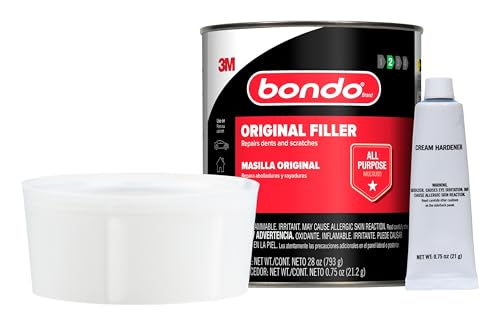


Customer reviews


Questions about Bondo Wood Filler
The filler reaches initial set in fifteen minutes and achieves full cure in thirty minutes at room temperature. You can begin sanding after thirty minutes for best results.
Cooler temperatures below 60°F extend cure time by ten to fifteen minutes, while warmer conditions above 80°F accelerate hardening. The surface will feel firm to the touch when ready for sanding, with no tackiness remaining.
Yes, the cured filler accepts oil-based stains, gel stains, water-based stains, and aniline dyes at the same absorption rate as natural wood. Sand the patch flush with surrounding wood using 220-grit paper before applying stain.
The epoxy matrix contains microscopic channels that allow penetrating finishes to soak into the surface just like solid lumber. For best color match, test your stain on a scrap piece with filler applied to verify the tone before finishing your project.
You can apply the filler up to one inch deep in a single pour without risk of incomplete cure or cracking. For cavities deeper than one inch, apply the filler in successive half-inch layers, allowing each layer to cure thirty minutes before adding the next.
Deep fills generate mild exothermic heat during cure, which is normal and won’t damage surrounding wood. The layering approach ensures complete hardening throughout the repair depth and prevents trapped air pockets.
The cured epoxy resists moisture penetration, ultraviolet exposure, and temperature cycling, making it suitable for exterior trim, siding, decking, and furniture repairs. It won’t support mold growth or rot, and maintains adhesion through freeze-thaw cycles.
For best exterior performance, prime and paint or seal the repair within seventy-two hours of application to protect both the filler and surrounding wood from prolonged UV exposure. The filler itself remains dimensionally stable outdoors indefinitely.
Yes, the cured filler develops tensile strength exceeding three thousand psi, which allows it to hold finish nails and wood screws securely without pre-drilling. The epoxy won’t crack or crumble under fastener pressure the way traditional putties do.
For best holding power, ensure the patch extends at least three screw-diameter depths around the fastener location. The material machines cleanly with drills and drivers without gumming bits or splitting.
Dispense equal amounts of resin and hardener onto a disposable mixing surface, then blend thoroughly with a putty knife for thirty seconds until the mixture shows uniform color with no streaks. The working time after mixing is approximately five minutes.
Use a 1:1 ratio by volume for proper cure — measuring equal ribbon lengths works well for small batches. Mix only the amount you can apply within five minutes, as the formula begins setting quickly once catalyzed.
No, the two-part epoxy formula cures through chemical reaction rather than solvent evaporation, which eliminates shrinkage. The cured patch maintains its exact applied volume and won’t pull away from repair edges over time.
Unlike water-based fillers that can crack as they dry, this epoxy remains dimensionally stable across temperature and humidity changes. Patches cured for the full thirty-minute period show zero cracking even under exterior weathering conditions.